How Do I Empower My Team to Make Decisions Without Me?
To empower your team to make decisions without you, use two frameworks together: a RACI matrix to define who owns each task, and a traffic light system to set how far people can act before they need you. Green means go, amber means check first, red means wait.
Firefighting. As soon as I ask a group of business owners how much time do they get pulled into project delivery to fight fires, or “collaborate” on a deliverable that your team should be able to handle, I have nods all around. It’s an experience that founders believe is part of the gig, and we’re here to dispel that notion. You have every intention to protect your time, and by Monday at 10 am, you’re interrupted with notifications and questions from your team. “Where do I find this?”, “What do I do next?”, “Am I able to do this?”, “Is it okay if…?” If any of that sounds familiar, you've had every one of these land on you before 10am. So what do you do? How do you get back the focus you need to work on the outcomes that actually drive the business not just in the interim, but in one, two, three…five years to come?
Here is your answer: Your team isn't waiting on you because they're incapable, they're waiting because nobody has told them where their authority ends. Two things fix it: clarity on who owns what (RACI), and clarity on how far they can go before they need you (traffic light system). Both of these things we will go through in this article.
Shouldn’t it be common sense?
If you have a team under your helm, then you would also know that common sense is a) not common and b) an excuse for poor management. But we don’t blame you. You didn’t start your business to become a manager, you started your business because you saw a gap in the market, or you had a solution to a problem that you had observed. When you grow, most people scale their businesses via building a team, and with that comes the issues you will only find when people are involved: different dynamics, catering to different motivators, keeping people accountable, keeping your people efficient, performance management, so on and so forth. The person that founded the business wasn’t born with the skillset to manage people, nobody hands that to you.
And the busier you get, the more team you hire, the more issues that arise, and the less time you have to focus on what only needs you to deliver, and the slower you become at responding to your team, essentially becoming the bottleneck. If you are the bottleneck what this alludes to is that you are wearing too many hats and the escalation route has become the default or everything is being escalated because nothing else has been defined. Your team are driving tasks, not outcomes and they aren’t leading in their roles. Teams are meant to make you faster, they create speed in the business, that’s why we have them. They are also meant to bridge the gap between capabilities that might be missing in your current skillset that also gives more value to your clients. This is also the number one reason why we always encourage not to hire another you. So what ultimately happens is that the team learns to chase.
So how do we fix this? We give our team authority. They will then learn through the confidence of achieving, to lead.
Start with who owns the work: RACI
Before you can hand over authority, everyone needs to agree on who is actually holding the work. That's what RACI does. It's four letters against every task or project, and it takes about twenty minutes to map:
Responsible: the person doing the work. Hands on the keyboard.
Accountable: the person who owns the outcome. If it doesn't happen, or it happens badly, this is who answers for it.
Consulted: the people whose input you need before it's finished. They shape the work.
Informed: the people who need to know it happened. They don't shape anything.
Let's put it against something you'd actually recognise. A new client onboarding. Your account manager is Responsible, they're the one sending the welcome pack, booking the kick off, setting up the project in your system. Your operations lead is Accountable, they own whether that client has a good first thirty days. Your finance person is Consulted, because the contract terms and payment schedule have to be right before anything goes out. And you, the founder, are Informed. You find out it's done. You don't approve it.
That last part is where most founders wince, so let's talk about the three things that make or break this.
One Accountable per task. Non negotiable. The temptation is to put two names down because two people care about it. What you've actually done is remove accountability entirely, because both of them can reasonably assume the other one has it. When something slips, and it will, you want one person to walk it back with. Not a conversation about who thought what.
Consulted is not approval. This is the sneaky one, and it's usually where founders quietly reinsert themselves. You put your name in the Consulted column because you want visibility, and what your team hears is "don't move until Nat has weighed in." Suddenly your calendar is full again and you cannot work out why. Being Consulted means your input gets considered. It doesn't mean the work stops and waits for you.
Informed is a broadcast, not a conversation. A message in the channel. A line in the weekly report. It is not a meeting, and it is not an invitation for you to reopen the decision after the fact. If you find yourself relitigating things you were only Informed on, your team will stop trusting the map and go back to asking you first.
Here's the catch though, and it's the reason most founders build a RACI and see nothing change. It tells your team who owns the work. It says nothing at all about how far they can take it before they need you. So the questions keep landing in your inbox, they just arrive with better attribution.
That's what the traffic light system is for.
Then set the boundaries: the traffic light system
This is a delegation of authority, and it's the piece that actually gets you your Monday mornings back. You take every decision your team touches and you sort it into three colours.
Green. Go. No consult, no check in, no waiting on you. They make the call and you find out later, if at all.
Amber. They take it to a defined point and then bring you in. The critical word there is defined. "Check with me if you're unsure" is not amber, it's just green with anxiety attached. Amber means: build the proposal, then send it to me before it goes to the client. Draft the response, then run it past me before you hit send. Name the point where they stop.
Red. Nothing happens until the conversation does. These are the decisions with real consequence, financially, legally, or reputationally, and they don't move without you.
Here's what it might look like for spend:
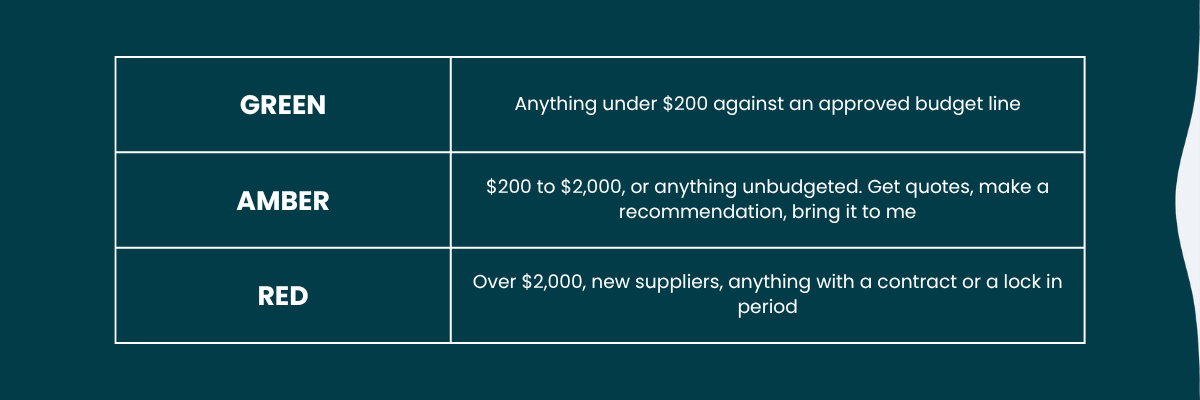
Example: Traffic light delegation table showing spending authority tiers for green, amber and red decisions.
Now, the part almost everyone misses when they first see this.
It looks like a set of guardrails, and for some people it is. But for your good people, it does the exact opposite. High performers hedge when they can't see where the edges are. They'd rather ask an unnecessary question than overstep, because overstepping feels like a career risk and asking only feels like an inconvenience to you. So they ask. Draw the edges clearly and they stop hedging, because now they know precisely how much room they've got. What you're handing them isn't a restriction, it's permission, in writing, that they can point to.
How to actually build one
Don't start with a blank page and try to imagine every decision your business might face. Start with what's already happening.
Go back through the last week. Every question that landed on you, every "is it okay if," every notification that pulled you out of what you were doing, write it down. That list is your first draft. Sort each one into a colour and you'll have covered most of what actually comes up.
When you're sorting, set green generously. I know the instinct runs the other way, but in every business I've walked into, the failure has been under delegating, not over delegating. A decision made slightly differently to how you'd have made it costs you far less than a team that can't move without you.
Green expands with demonstrated judgement, not with tenure. Someone eighteen months in who's shown you they think it through gets more green than someone who's been there five years and hasn't. Say that out loud to your team, because it also gives the ambitious ones a visible path to more autonomy.
Then review it. Quarterly at minimum, and every single time you hire. A traffic light built for a team of three does not survive a team of six. And if it’s easier to create, when I come in to manage and lead my clients team, I create a traffic light system for each role. The newer the role, the less green there is, however what should happen is that as that person builds more confidence, and time within the business, we should be seeing a lot less red and amber. Looking over these are also a great way of understanding the health of your business and if you’re ready to scale with your existing team.
Worked example
While this may not be something that lands in your inbox a lot, most of the founders I work with hesitate with this because of the “worst case scenario”. For most of us it’s when things aren’t going well with a client. How could we let our team handle this? Below is my take.
The RACI
Your account manager is Responsible, they're the one who responds, has the conversation, and sorts it out. Your operations lead is Accountable, they own whether that client relationship recovers. Your delivery lead is Consulted, because you need to know what actually went wrong before anyone promises anything. You're Informed.
The traffic light.
Green: acknowledging the complaint, booking a call, apologising for the experience, fixing it within the existing scope.
Amber: offering anything outside scope, redoing work at no cost, or extending a deadline. Build the recommendation, then bring it to your operations lead, and if that is you because you do not have one (Hi, I can help, this is my role), then they bring it to you.
Red: discounts, refunds, credits, or anything that touches the contract.
But here is the real test and again, a reason why a lot of my clients before working with us haven't stepped back or felt the need to switch off. So let’s go through it. It's 4pm on a Friday, you're at your daughter's assembly, and your phone is in your bag.
Your account manager reads the email. She acknowledges it within the hour and books a call for Monday morning, because that's green and she doesn't need anyone. She talks to your delivery lead, finds out the brief changed halfway through and nobody documented it, and drafts a plan to redo the affected section next week. That's amber, so it goes to your operations lead, who approves it. And again, if you’re wearing this hat (you shouldn’t) the plan is sent to you for you to review prior to the Monday meeting so that you’re prepped and ready to go. And if you have an operations lead, or a Fractional General Manager the client has a response, a call in the diary, and a plan, all before you've even looked at your phone.
The one thing nobody did was offer money back. That's red, and red waits until Monday. Which is fine, because nobody asked for it.
That's the whole point. Not that your team handles everything. That they handle the eighty percent that doesn't need you, and the twenty percent that does is genuinely worth interrupting your weekend for.
And the reason we keep reiterating that you shouldn’t be in the operations seat, is because as a founder you have three jobs: brand, hiring and sales. Operations can be delegated.
Now run your own worst case through it.
The frameworks fail without the behaviour change
You can build both of these beautifully and still have your team in your inbox on Monday, because a framework tells people where the lines are, it doesn't teach them how to think. That part you have to set as an expectation, and then hold.
Four rules I give every team I work with:
Exhaust every other avenue first. Before it comes to me, you've checked the drive, you've checked the process doc, you've asked the person who did it last time. I'm the last resort, not the first.
Come with three options and a recommendation. Not a problem. Anyone can bring me a problem. I want to know what you'd do and which one you'd pick. This also helps me find their knowledge or capability gaps to then help them become better in this space.
Tell me your rationale. Not just what you'd choose, but why. This is the bit that actually develops judgement, and it's also how I work out how much green you're ready for.
Tell me what it costs. How much of your time does this take versus mine? Most people have genuinely never considered it. Once they do, half the questions stop coming, because they realise they were about to spend forty minutes of my time to save themselves five.
Now the honest counterpart, because this is a two way street, and where a lot of my clients need support themselves. Again, you did not start your business to manage people.
None of it holds if you don't hold up your end. If your team brings you a red and you take three days to answer it, you've taught them the system doesn't work. They'll go straight back to chasing, and they'll be right to. When you narrow the number of things that come to you, the deal is that the things that do come get answered fast. Same day, ideally. That's the trade you're making, and you don't get the quiet without it. For busy founders, which are most, I also have a system for daily approvals so you do not get questions, and notifications infiltrating your day, instead a time set aside for the approvals instead.
What the first month actually feels like
I'd rather tell you this now than have you abandon it in week two. It gets noisier before it gets quieter. People will test the lines, mostly by bringing you things that are clearly green, because they're checking whether you meant it. Every time you answer one of those instead of sending it back, you undo a bit of the work. Send it back. Kindly, but send it back.
And some decisions will get made differently to how you'd have made them. Not wrong, just not yours. This is the actual cost of the trade and there's no version of this where you avoid it. You have to let most of them stand, because the moment you start overturning green decisions, everything quietly reverts to amber and you're back where you started. And you might surprise yourself, sometimes our team does it better than us, that’s why we hired them right?
Give it a month before you judge it. Around week four is when the questions drop off and you notice you've had a whole morning to yourself.
And if you do all this and they still don't step up?
Then you have a people issue, not a structural one. That's a real thing and I'm not going to pretend otherwise.
But here's the order I work in, and I'd ask you to hold to it: we don't assume. Frameworks first, always. Because the founder who tells me a team member is disengaged is usually describing someone who has never been told what they own, has never been given room to move, and has been quietly corrected every time they tried. That's not an attitude problem. That's a person who's learned that initiative is expensive.
Give it a proper run. Clear ownership, clear authority, expectations set out loud, and you holding up your end of it. If someone still isn't leading in their role after that, you'll know, and you'll know it clean with evidence, not a feeling. That's a performance conversation you can actually have, and it's a very different conversation to the one you'd be having now.
You didn't come here for a framework.
You came here because you want a week where you can think, where Monday at 10am belongs to you, and where your team is moving without needing a piece of you to do it.
That's what these two tools buy you.
And you don't have to do it alone, if you'd rather talk it through, from one founder to another, book a call and I'll either point you in the right direction or show you how we'd do it together.
Otherwise, start here. I've built the traffic light template I use with every client, with the categories already mapped so you're not starting from scratch. Grab it below, spend twenty minutes on it this week, and take it to your team.